
Product guide
How Running Shoes Are Made: Foams, Plates, Outsoles & Testing
How a running shoe is built — midsole foams, engineered mesh uppers, plates, outsole rubber and the tests that decide whether it survives the road.
Running shoes are the most engineered category in footwear. A daily trainer, a lightweight racer and a carbon-plate marathon shoe share a silhouette but almost nothing else: different foams, different lasts, different plates and different outsole rubber. Choosing the right running shoe manufacturer in China is really about whether the factory can develop those systems — not just assemble an upper onto a sole. This guide explains how running shoes are made, so you can brief a factory and get a shoe that actually performs.
It is written from inside a working factory. DOING has manufactured footwear since 2002, runs 4 production lines and a team of 589, and produces 200,000+ pairs a month from its own factory plus a vetted partner-factory network, with amfori BSCI and HBI (Hanesbrands) audit reports. Running and sports shoes are a core category, and we have developed genuine carbon-plate marathon shoes for a professional buyer.

What should a running-shoe factory be able to do for you?
A real running-shoe manufacturer engineers the midsole system — foam, geometry and, for racers, a plate — not just the upper. At DOING that means tooling full-length, forefoot and spoon-shaped carbon plates or sourcing them, pairing them with EVA, PU, E-TPU or supercritical/PEBA-type foams, and building on Strobel, cemented or direct-injection lines. Planning numbers: MOQ ~1,200 pairs per style (2–3 colours), samples 2–4 weeks, production 30–60 days, 200,000+ pairs a month capacity across 4 own lines and a partner network.
What actually goes into building a running shoe
A running-shoe manufacturer develops the last and fit, engineers the midsole (foam, geometry and — for racers — a plate), designs a breathable upper, matches an outsole rubber for grip and durability, then builds and approves samples before bulk production and QC. The hard part is the midsole system: energy return, stability and weight are decided by foam choice and geometry, and a factory that only cements pre-made soles cannot tune that for you.
Types of running shoes we manufacture
- Daily trainers — cushioned, durable everyday road shoes; the volume backbone of most running ranges.
- Tempo / lightweight trainers — lower weight, firmer foam, faster-day shoes.
- Carbon-plate racers — a stiff plate in a high-rebound foam for marathon and race day.
- Trail running shoes — aggressive lug outsoles, rock plates, protective and sometimes waterproof uppers.
- Stability shoes — medial support via firmer foam or guide rails for over-pronation.
- Minimalist / lightweight — low-drop, flexible, close-to-ground trainers.
Each of these maps to a specific buyer search — “trail running shoe manufacturer”, “lightweight running shoe factory”, “carbon-plate running shoe OEM” — and each is a real development capability.

Foams: the heart of a running shoe
Midsole foam decides how a shoe feels and what it costs:
| Foam | Feel | Best for | Note |
|---|---|---|---|
| EVA / moulded EVA | Light, balanced | Daily trainers, value ranges | Most economical; compresses over time |
| PU | Firm, durable rebound | Long-life trainers | Heavier, very durable |
| TPU bead (E-TPU) | Bouncy, resilient | Cushioned trainers | High energy return, holds up |
| Supercritical / PEBA-type | Light, high rebound | Performance & racing | Premium; pairs with a plate |
The foam is chosen together with the plate, the last and the price target during development — not picked from a catalogue afterwards.
Uppers, plates and outsoles
- Uppers — engineered/jacquard mesh for breathability and structured hold, with welded or stitched overlays; racing uppers go ultra-light and minimal.
- Plates — carbon-fibre or nylon/TPU plates tune stiffness and propulsion. A credible carbon plate is engineered as a system with the foam and geometry.
- Outsoles — high-abrasion rubber at wear zones, exposed foam to save weight, and deep lugs for trail.
Specify these precisely in your tech pack. Our guide to choosing shoe materials covers how to write a spec a factory can actually match.
Carbon plates: where buyers actually get burned
This is the part of running-shoe sourcing where the gap between what is promised and what arrives is widest. A plate is invisible once the shoe is built, so “carbon plate” on a spec sheet is easy to write and hard for a buyer to verify.
The failure we see most often is not a factory refusing to fit a plate. It is a plate that is not what the buyer thought they were buying — a cosmetic layer, a low-modulus composite, or a generic stock plate dropped into a midsole it was never matched to. A professional Korean marathon buyer came to us for exactly this reason: plates offered elsewhere had not held up for runners who race in the shoes. They tested our development themselves before committing — read the carbon-plate marathon case.
Plate shapes we tool
| Plate | Shape | Typical use |
|---|---|---|
| Full-length | Runs heel to toe | Marathon racers; maximum propulsion and stiffness |
| Forefoot (half) plate | Front section only | Tempo and race-day shoes wanting snap without full rigidity |
| Spoon / shovel | Curved, scooped geometry | Tuned rocker and toe-off feel |
We can tool a plate to your geometry or source a plate from the market — both are normal routes. Custom tooling costs more and takes longer, and it is the only way to control stiffness distribution and the curve precisely. Sourcing is faster and suits a first commercial model.
How we check a plate is actually doing its job
A plate only works as a system with the foam and the last. Two physical checks matter, and they are the questions to put to any factory:
- Flexural stiffness and flexural modulus — measured by three-point bending to ASTM D790, the standard that covers reinforced plastics including high-modulus composites. This is what separates a structural plate from a decorative one, and it is reported as flexural stiffness (N·mm²) and flexural modulus (MPa).
- Plate-to-foam peel strength — measured to ASTM D903 (180° peel, reported as force per unit width). A stiff plate that debonds from the foam under repeated loading fails in the field even though it passed a stiffness check.
We run these methods during development. We do not publish values, and we do not claim third-party plate reports — if a supplier shows you numbers, ask which standard, which specimen and which lab produced them before you treat them as evidence.
Foam and plate are one decision, not two
| Foam | With a plate | Sensible pairing |
|---|---|---|
| EVA / moulded EVA | Plate dominates the feel | Value racers, plated trainers at a price point |
| PU | Heavy for racing | Rarely paired; better for long-life trainers |
| E-TPU (bead) | Bouncy but softer underfoot | Plated daily-trainer crossovers |
| Supercritical / PEBA-type | Foam and plate reinforce each other | Genuine marathon racers |
Supercritical and PEBA-type foams, standard EVA and everything between are all available. As we tell buyers directly: the difference is positioning and cost, not whether we can make it.

What we test before a running shoe ships
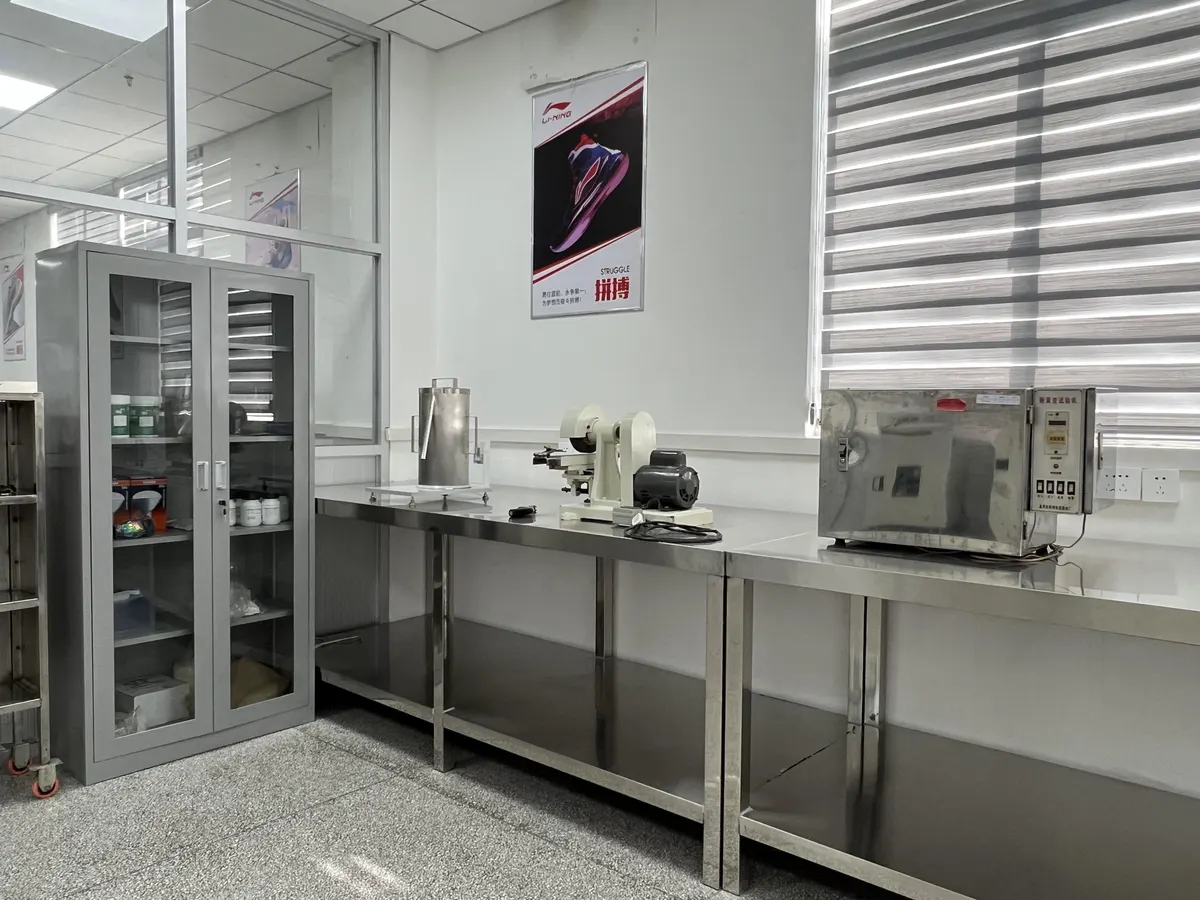
Development decides whether a shoe is good. Testing decides whether it survives the customer. These are the finished-shoe thresholds we hold in our own lab — not category averages, our internal pass marks:
| Test | Our pass mark |
|---|---|
| Flex resistance (room temperature) | ≥ 60,000 cycles, no new cracks |
| Flex resistance (−20 °C) | ≥ 40,000 cycles, no cracking |
| Abrasion, finished shoe | ≤ 10 mm (national method) |
| Upper tensile strength | ≥ 2.5 kg/cm at stress points, ≥ 1.8 kg/cm elsewhere |
| Lining colour fastness, dry and wet | ≥ grade 3 |
A shoe fails if a new crack appears, the flex point delaminates, the mesh breaks or trims come loose. For running shoes the flex test is the one that matters most, because a road shoe lives its whole life at that one bend point — we show a real flex test on our floor in how we stop soles cracking, and the full standards matrix is on our footwear testing standards page.
Five mistakes we watch buyers make
- Specifying a plate before specifying the foam. The plate is only half the system; a stiff plate in soft, low-rebound foam feels worse than no plate at all.
- Copying a competitor’s stack height without their last. Stack and drop only make sense on the geometry they were designed around.
- Approving a sample indoors. A running shoe is validated on the road, over distance, by a runner — not on a desk.
- Treating colourways as free. Each colour carries its own material minimum; plan colourways inside the 1,200-pair style minimum (2–3 colours), not on top of it.
- Leaving the plate unverified. If nobody has bent it to a standard, “carbon plate” is a marketing word, not a specification.
Construction
Most running shoes use Strobel construction — the upper is stitched to a fabric sock and lasted onto the midsole — for a flexible, lightweight result. Cementing and direct injection are used for specific models. Ask which the factory runs in-house; the construction affects flexibility, weight and how the shoe is repaired or tooled.
MOQ, samples, lead time and capacity
Real numbers you can plan around at DOING:
- MOQ — around 1,200 pairs per style, split across 2–3 colours, with samples approved before bulk.
- Samples — 2–4 weeks once design, foam and materials are confirmed.
- Production — 30–60 days depending on construction, materials and quantity.
- Capacity — 200,000+ pairs a month from our own factory plus partner-factory capacity.
Carbon-plate and multi-density midsoles need more development time and tooling; simple cemented trainers are the fastest and most economical.
How to choose a running-shoe manufacturer
- Judge the midsole, not the logo. Ask how they develop foam and geometry, and whether they can make a plate work as a system.
- Order a paid sample and run in it. A running shoe is validated on the road, not in photos.
- Check the category fit. A factory strong in casual shoes may not develop performance running well — ask for running references.
- See the line and QC. Request factory, line and QC photos or a live video walkthrough.
- Start protected. Agree specs, AQL and timeline in writing, use staged payments, and book a pre-shipment inspection.
Our deeper guide on how to find a reliable shoe manufacturer in China expands each step.
Why brands develop running shoes with DOING
DOING is a trading-and-manufacturing partner: factory pricing with in-house development, QC and export. We develop road, trail, lightweight and carbon-plate running shoes; we match foam, plate and last as a system rather than assembling parts; and we back it with 4 own production lines, 589 people, 200,000+ pairs a month and amfori BSCI & HBI audits. When a professional Korean marathon buyer needed real carbon-plate racers after the plates offered elsewhere did not hold up, we developed them — see the carbon-plate marathon case.
Ready to develop a running shoe — or want a factory to pressure-test your midsole spec? Send us your design or a reference sample and we will come back with foam and plate options, construction, MOQ and a quote. You can also see our running-shoe manufacturing service and the factory.
Part of our footwear manufacturing guides by product type.
Frequently asked questions
What types of running shoes can a Chinese manufacturer produce?
A full-service running-shoe manufacturer in China can produce road (daily trainer, tempo, race) shoes, trail running shoes, lightweight and minimalist trainers, stability and cushioned models, and carbon-plate racing shoes. At DOING we develop across these on our own lines plus a partner-factory network, using Strobel, cementing and injection construction.
What is the MOQ for custom running shoes?
A typical running-shoe MOQ is around 1,200 pairs per style, which can be split across 2–3 colours. DOING makes samples so you can validate a design before committing to the first production run at MOQ.
Can a factory make carbon-plate running shoes?
Yes, but few do it well. A real carbon-plate racer needs the plate geometry, the foam and the last to work together, not just a plate dropped into a midsole. DOING has developed genuine carbon-plate marathon shoes for a professional Korean buyer after plates offered elsewhere failed to hold up.
What foams are used in performance running shoes?
EVA and moulded EVA for value and daily trainers; PU for durable rebound; TPU-based and supercritical (PEBA-type) foams for high energy return in performance and racing shoes. The foam is matched to the shoe's purpose, plate and price target during development.
How long do running-shoe samples and production take?
Plan for 2–4 weeks for samples once design, foam and materials are confirmed, and 30–60 days for bulk production depending on construction, materials and quantity. Carbon-plate and multi-density midsoles sit at the longer end.
Can you tool a carbon plate to our own geometry, or only use stock plates?
Both. DOING can open a mould and tool a carbon plate to your geometry — full-length, forefoot (half) or spoon/shovel shape — or source a plate from the market when you want a faster, lower-cost route to a first commercial model. Custom tooling is the only way to control stiffness distribution and curvature precisely; sourcing is quicker. We will tell you which one your target price and timeline actually supports.
How do you verify a carbon plate is real and not decorative?
Two physical checks during development. Flexural stiffness and flexural modulus by three-point bending to ASTM D790, the standard covering reinforced plastics including high-modulus composites, reported as N·mm² and MPa. Plate-to-foam peel strength to ASTM D903, a 180° peel reported as force per unit width, because a stiff plate that debonds under repeated loading still fails in the field. We publish the methods, not values, and we do not claim third-party plate reports — ask any supplier which standard, specimen and lab produced any number they show you.
Do you test finished running shoes, and to what level?
Yes, in our own laboratory. Our internal pass marks for a finished shoe include at least 60,000 flex cycles at room temperature and 40,000 cycles at −20 °C with no new cracking or flex-point delamination, abrasion of 10 mm or less by the national method, upper tensile strength of at least 2.5 kg/cm at stress points, and lining colour fastness of grade 3 or better dry and wet. Third-party laboratories such as SGS, BV, Intertek or SATRA are engaged on request for compliance and certification work.
Will you sign an NDA before we send our running-shoe designs?
Yes. Signing an NDA before receiving designs is routine for us, not an exception, and it is already part of how we start brand projects. Send the NDA with your enquiry and we will return it signed before you share tech packs, lasts or samples.
Can you match or improve on a reference running shoe we already sell?
Yes, and it is one of the most common ways projects start. Send the reference pair and we will assess the last, midsole system, foam type, plate if any, outsole rubber and construction, then come back with what we would match, what we would change and why, plus foam and plate options against your target price. A physical reference is far more useful than photographs.
Where in China are running shoes made?
Running-shoe production is concentrated in Fujian province — Quanzhou and Jinjiang are the centre of sports-shoe manufacturing, with dense supply chains for foams, engineered mesh, plates and outsoles. That is where DOING is based.
Sourcing footwear from China?
DOING is a footwear trading & manufacturing partner — OEM/ODM, development, QC and export. Tell us your product, market and MOQ.
Get a Quote